
ido4specs
You wrote (or were handed) a spec describing what to build. It’s a thoughtful document — stakeholders weighed in, success conditions are agreed, the constraints are real. It’s also a wall of prose. The question is now: what exactly are we building, in what order, and how do we hand that to engineering without losing what the spec authors meant?
ido4specs is a Claude Code plugin that runs the gap. It reads the strategic spec, looks at the actual codebase (or the integration targets if it’s greenfield), and produces a technical spec: a structured markdown artifact where every capability has tasks with effort, risk, AI suitability, dependencies, and code-verifiable success conditions. Plain markdown. Any downstream tool can ingest it — ido4dev turns it into GitHub issues, your existing PM tooling can parse it, your team can read it.
In the ido4 suite, ido4shape captures the WHY and the WHAT (strategic intent + capabilities). ido4specs takes the WHAT and adds the HOW (concrete tasks grounded in your codebase). ido4dev — or any downstream tool you bring — handles execution (turning the spec into issues your team works against). This page is about the middle plugin: WHAT → HOW.
The point is traceability without ceremony. The strategic spec author sees their language preserved. Engineering sees concrete tasks with file paths. Reviewers see two independent quality layers (deterministic + qualitative). And nothing auto-progresses — there’s a human checkpoint at every phase boundary.
Pipeline at a glance
ido4specs Pipeline — full flow with artifacts and checkpoints
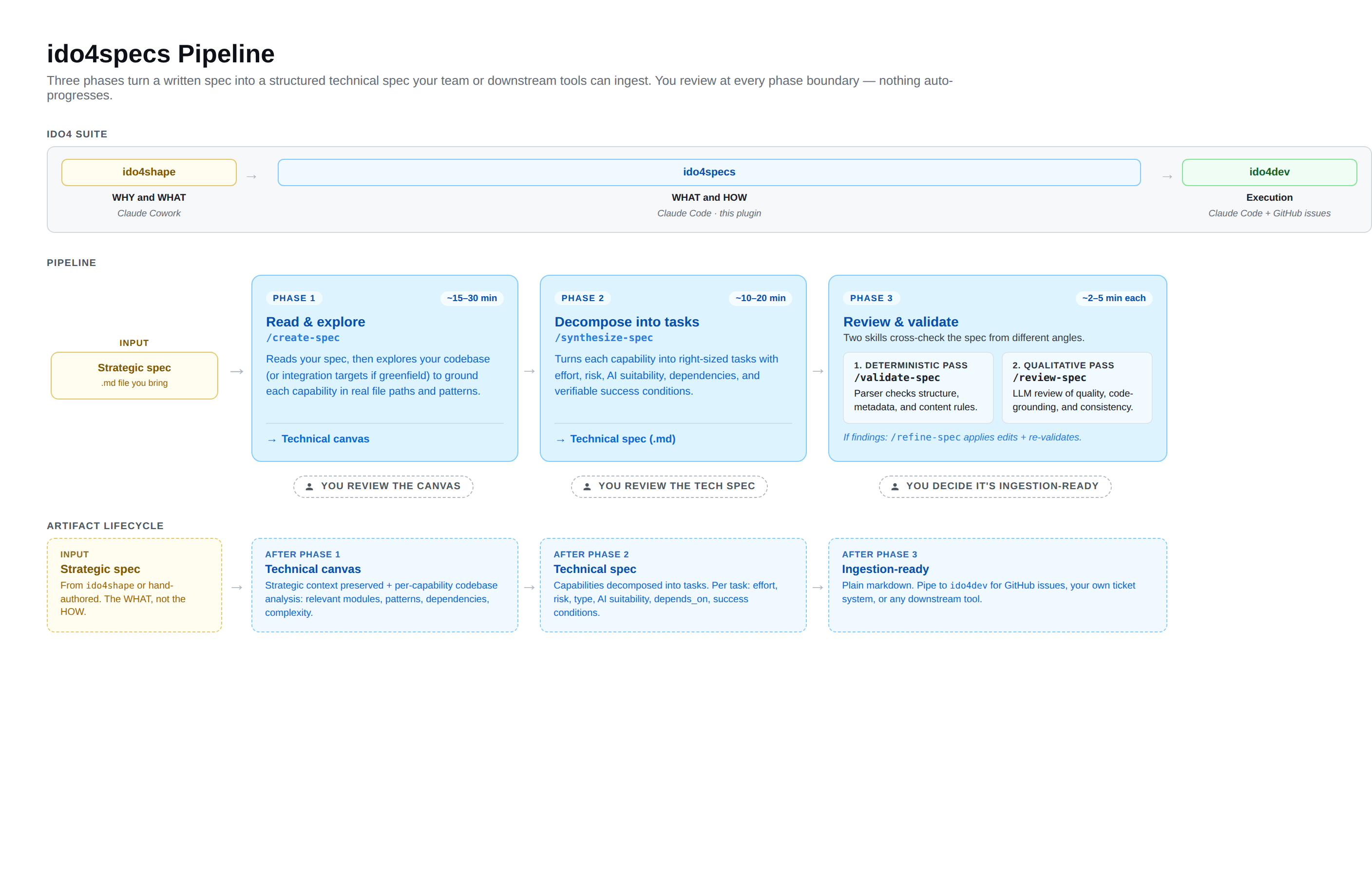
Three phases, three artifacts, three review checkpoints:
| Phase | Skill | Wall time | Output |
|---|---|---|---|
| 1 | /create-spec | ~15–30 min | Technical Canvas |
| 2 | /synthesize-spec | ~10–20 min | Technical Spec (.md) |
| 3 | /review-spec + /validate-spec | ~2–5 min each | Findings + verdict |
| 3+ | /refine-spec | ~1–2 min | Edited spec, re-validated |
Total wall time for a 30+ capability spec: typically 30–60 minutes, mostly Phase 1 (codebase analysis is the heavy stage). You can break between phases — a fresh session picks back up from the last artifact.
What this doesn’t do
ido4specs is deliberately scoped. It does not:
- Write code. It produces a spec describing tasks. Engineering (or your AI coding tools) writes the code from there.
- Run tests or CI. Success conditions in the spec are verifiable, but the verification happens elsewhere.
- Manage issues or projects. It outputs markdown.
ido4dev(or your tool) does the GitHub-issue creation. - Enforce a methodology. The technical spec is methodology-neutral — no Scrum, no Shape Up, no Hydro. Your team’s process layers on top.
- Replace strategic spec authoring. It consumes a strategic spec; producing one is
ido4shape’s job (or your existing authoring process).
What it does do is the translation layer between strategic intent and engineering execution — which is the gap most spec workflows leave open.
Where to go from here
- Get started — install, prerequisites, and the first-run command flow
- How it works — detailed walkthrough of each phase, what each skill does, what artifacts are produced
- Skill reference — per-skill pages with stages, inputs, outputs, and failure modes:
/create-spec·/synthesize-spec·/validate-spec·/review-spec·/refine-spec·/doctor - FAQ + troubleshooting — common questions, scenario recipes, and what to do when something goes wrong
Reference
- Plugin source and changelog: github.com/ido4-dev/ido4specs
- Marketplace install:
/plugin install ido4specs@ido4-pluginsfrom inside Claude Code - Format reference:
@ido4/tech-spec-formaton npm — the parser package the plugin ships - Upstream pair: ido4shape helps you author the strategic spec
- Downstream pair: ido4dev ingests the technical spec into GitHub issues