
Methodologies
ido4 doesn’t force a methodology on you. It ships three — pick the one that fits how your team works, or extend one to make it yours.
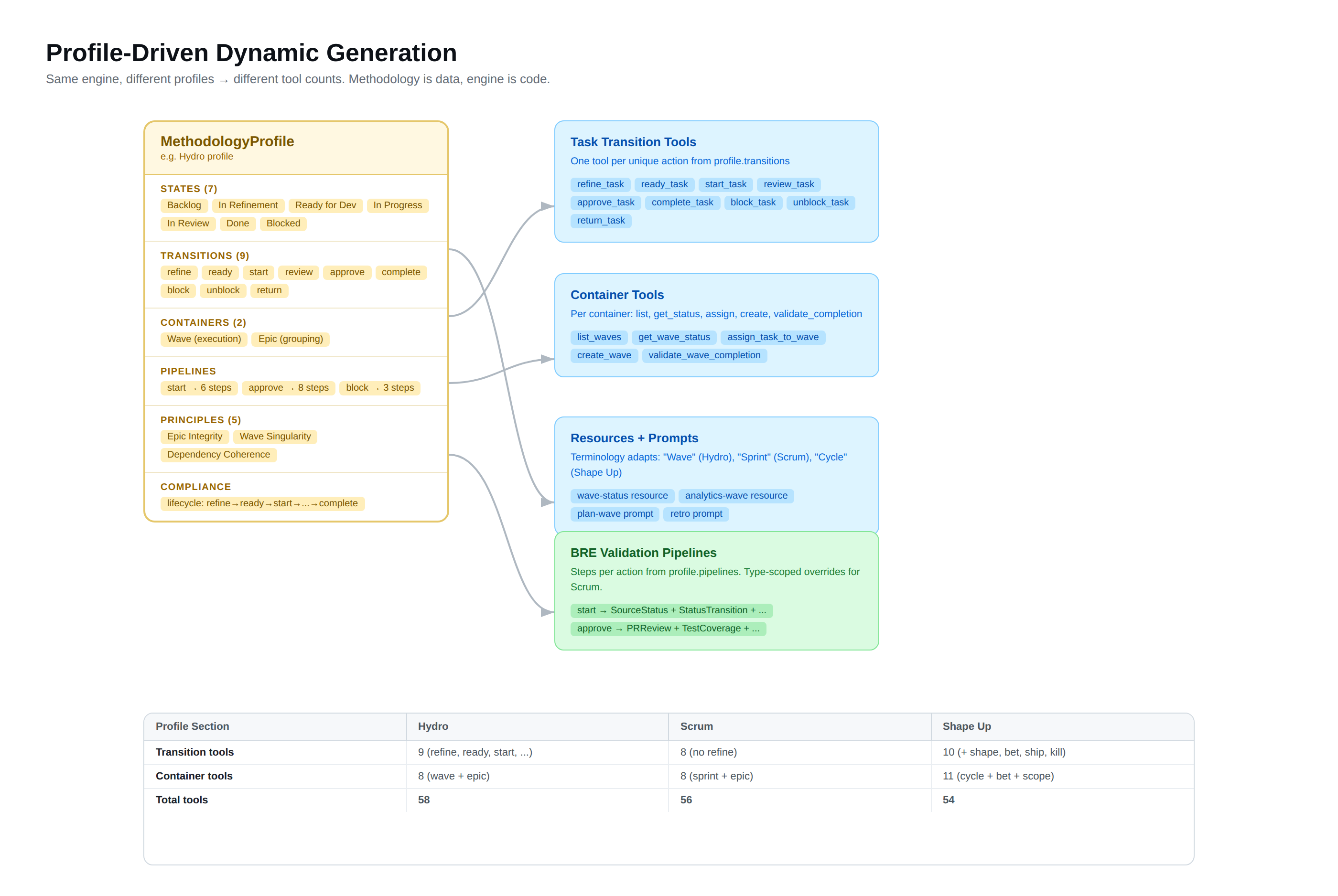
Methodologies are profiles — data structures that define states, transitions, containers, validation pipelines, and principles. The engine reads the profile and generates everything: tools, prompts, BRE pipelines, compliance scoring. Tool counts vary because each methodology has different containers and state machines.
Profile Generation — how a profile drives tool and pipeline generation
For teams that ship features whole.
Hydro organizes work into waves — self-contained delivery units executed one at a time. Related tasks group into epics, and the defining rule is: all tasks in an epic must be in the same wave. You don’t ship half a feature.
This is the methodology built for AI-augmented consulting — where a small senior team governs multiple AI agents delivering complete features to enterprise clients.
Why Hydro
- Epic Integrity prevents partial feature delivery — no shipping auth tokens in wave-002 and RBAC in wave-003
- Wave sequencing gives clear execution order with dependency coherence
- Five principles provide comprehensive governance without methodology overhead
- Refinement pipeline (Backlog -> In Refinement -> Ready for Dev) ensures tasks are well-specified before agents touch them
The workflow
Backlog -> In Refinement -> Ready for Dev -> In Progress -> In Review -> Done | Blocked7 states, 9 transitions (including backward transitions and administrative completion).
Containers
| Container | Role | Key Rule |
|---|---|---|
| Wave | When work happens | Only one active at a time. Named wave-001-auth-system. |
| Epic | What ships together | All tasks in an epic must share the same wave. |
The five principles
- Epic Integrity — All tasks in an epic, same wave. Non-negotiable.
- Active Wave Singularity — One wave at a time. Focus.
- Dependency Coherence — Can’t build floor two before the foundation.
- Self-Contained Execution — Every wave has everything it needs.
- Atomic Completion — A wave at 90% is not complete.
58 MCP tools generated from profile.
For teams with different types of work.
Scrum organizes work into sprints with a defining feature that sets it apart: type-scoped validation pipelines. User stories, bugs, spikes, and tech debt each get different quality gates. A story needs acceptance criteria before entering the sprint. A spike doesn’t need PR approval to close. Tech debt requires two reviewers.
This isn’t Scrum with governance bolted on — it’s Scrum where the Definition of Ready and Definition of Done are enforced by code, not by team norms.
Why Scrum
- Type-scoped DoR/DoD — Different work deserves different validation. The BRE knows the difference.
- Epics span sprints — Unlike Hydro, there’s no epic-sprint integrity rule. An epic can take three sprints. That’s normal.
- Familiar terminology — Product Backlog, Sprint Backlog, User Stories. Your team already knows this.
- Lightweight governance — One principle (Sprint Singularity) plus type-aware pipelines. Not five principles — just the ones that matter for sprint execution.
The workflow
Product Backlog -> Sprint Backlog -> In Progress -> In Review -> Done | Blocked6 states, 8 transitions.
Containers
| Container | Role | Key Rule |
|---|---|---|
| Sprint | When work happens | Only one active. Named Sprint 14. |
| Epic | Long-running themes | Spans sprints freely. No integrity constraint. |
Type-scoped pipelines
This is Scrum’s superpower in ido4:
| Work Item | Planning (DoR) | Approval (DoD) |
|---|---|---|
| User Story | Needs acceptance criteria + effort estimate | Standard approval + context |
| Bug | Needs reproduction steps | Standard (skips dependency check on start) |
| Spike | Minimal — just the status transition | Relaxed — no PR approval needed |
| Tech Debt | Standard | Requires 2 PR reviewers |
| Chore | Standard | Standard |
The BRE checks plan:story, plan:bug, plan:spike as separate pipelines. Different work, different gates.
56 MCP tools generated from profile.
For teams that bet on outcomes, not tasks.
Shape Up works in fixed cycles (default 6 weeks) where teams commit to bets — shaped pitches with defined appetite. The defining discipline: the circuit breaker. If a bet doesn’t ship by cycle end, it’s killed. No extensions. No carry-over. Scope gets hammered, not timelines.
This forces honesty about scope — and it’s the only methodology in ido4 with two terminal states: Shipped and Killed. Both are valid outcomes.
Why Shape Up
- Circuit breaker kills runaway projects before they eat your roadmap
- Fixed appetite means time is the constraint, scope is the variable. Agents cut scope, not quality.
- Shaping pipeline (Raw Idea -> Shaped -> Bet On) ensures work is well-understood before building starts
- Killed bets are healthy — they mean the governance worked, not that the team failed
The workflow
Raw Idea -> Shaped -> Bet On -> Building -> QA -> Shipped | | Blocked Killed8 states, 10 transitions. The kill transition is available from Building, QA, and Blocked — the circuit breaker can fire at any point.
Containers
| Container | Role | Key Rule |
|---|---|---|
| Cycle | Fixed time period | 6 weeks. Only one active. Named cycle-001-notifications. |
| Bet | Committed pitch | All tasks in a bet share the same cycle. |
| Scope | Optional sub-grouping | Within a bet. Not managed by governance. Emerges during building. |
Four principles
- Bet Integrity — All tasks in a bet, same cycle.
- Active Cycle Singularity — One cycle at a time.
- Circuit Breaker — Unfinished at cycle end = killed. No extensions.
- Fixed Appetite — Time fixed, scope variable.
54 MCP tools generated from profile.
Choosing your methodology
Your team ships complete features at once (consulting delivery, enterprise milestones) → Hydro. Epic Integrity ensures features don’t ship partially.
Your team works on diverse work types (stories, bugs, spikes, tech debt) with different quality requirements → Scrum. Type-scoped pipelines enforce the right quality gates per work type.
Your team bets on outcomes with fixed time budgets (product-driven orgs, startups) → Shape Up. The circuit breaker kills unfinished bets — scope gets hammered, not timelines.
Detailed comparison
| Question | Hydro | Scrum | Shape Up |
|---|---|---|---|
| Do features need to ship whole? | Yes — Epic Integrity | No — epics span sprints | Yes — Bet Integrity |
| Different quality gates per work type? | No | Yes — type-scoped pipelines | No |
| What happens to unfinished work? | Stays in wave until done | Carries over to next sprint | Killed by circuit breaker |
| How many governance principles? | 5 | 1 | 4 |
| Shaping/refinement pipeline? | 2-stage (refine, ready) | 1-stage (plan) | 2-stage (shape, bet) |
| Terminal states | Done | Done | Shipped, Killed |
How profiles work
A methodology profile defines everything the engine needs:
| Section | What It Controls |
|---|---|
states | Workflow states with categories (todo, active, done, blocked) |
transitions | Valid state changes with source/target mappings |
containers | Container types with singularity, completion rules, naming |
integrityRules | Relationships between containers |
principles | Named governance rules with enforcement mechanisms |
workItems | Work item types with lifecycle overrides |
pipelines | BRE validation steps per transition (and per type) |
compliance | Expected lifecycle and scoring weights |
The engine generates tools, prompts, and validation pipelines from this profile. Changing methodology = changing the profile, not the code.
Custom profiles
Extend a built-in profile and override what you need:
{ "extends": "scrum", "id": "my-team", "pipelines": { "approve": { "steps": [ "StatusTransitionValidation:DONE", "ApprovalRequirementValidation", "PRReviewValidation:2", "TestCoverageValidation:90", "SecurityScanValidation" ] } }}Everything else inherits from Scrum. See Configurable Methodology for full details.
At a glance
| Hydro | Scrum | Shape Up | |
|---|---|---|---|
| States | 7 | 6 | 8 |
| Transitions | 9 | 8 | 10 |
| Containers | 2 | 2 | 3 |
| Integrity Rules | 2 | 0 | 1 |
| Principles | 5 | 1 | 4 |
| Work Item Types | 5 | 5 | 1 |
| Type-Scoped Pipelines | No | Yes | No |
| Terminal States | 1 | 1 | 2 |
| MCP Tools | 58 | 56 | 54 |