
/ido4dev:decompose
The decompose skill orchestrates the strategic-to-technical spec pipeline — transforming a strategic spec (from ido4shape) into a technical spec with implementation tasks grounded in the actual codebase. It doesn’t just break down a spec — it explores your codebase to find the right task boundaries and judges effort/risk based on actual code complexity, not guesses.
Decomposition Pipeline — full pipeline architecture
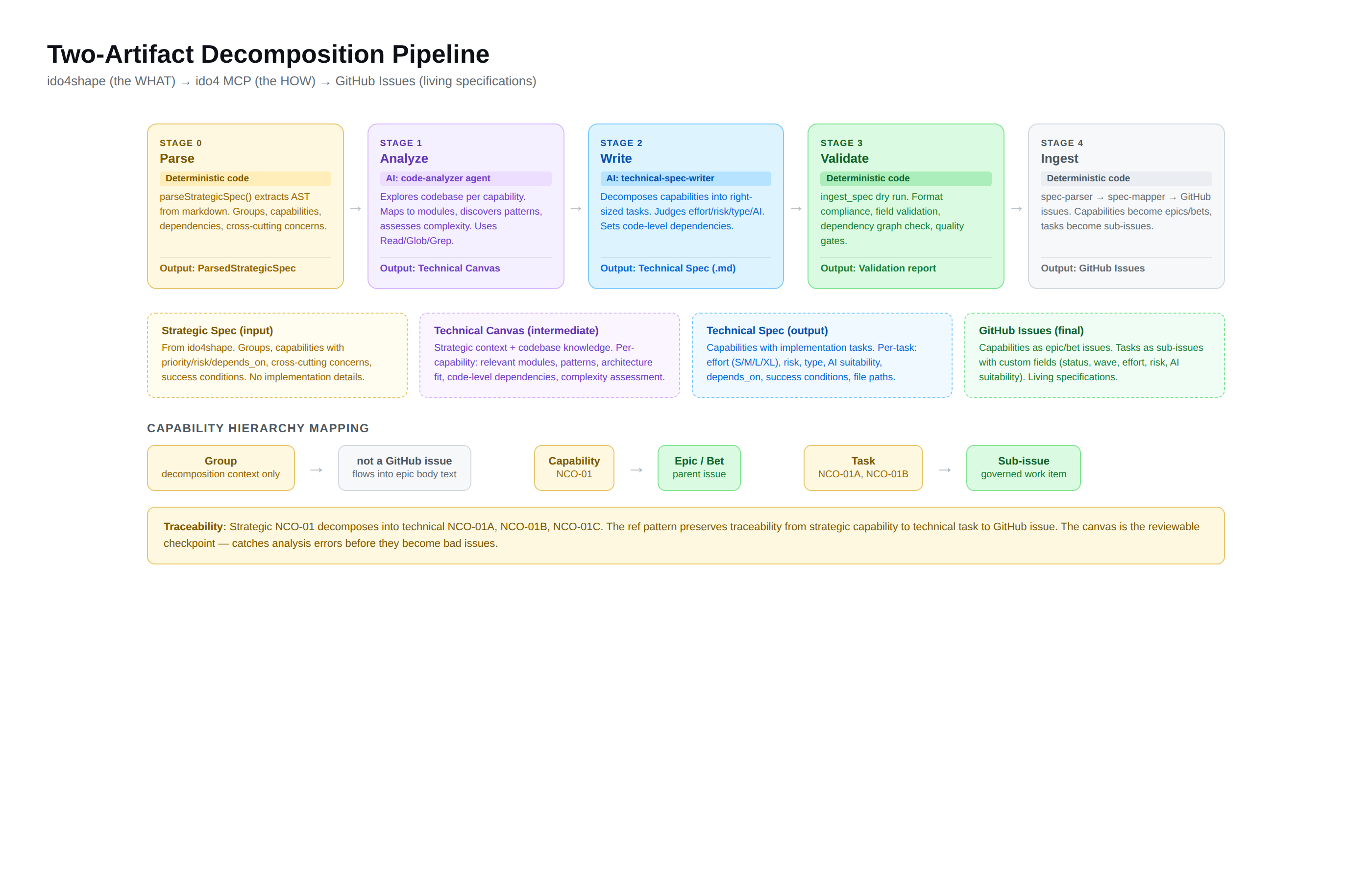
What It Does
/ido4dev:decompose path/to/strategic-spec.md runs a four-stage pipeline:
Strategic Spec (from ido4shape) | v+---------------------------+| 1. Parse | strategic-spec-parser extracts| (deterministic) | structured AST from markdown+---------------------------+ | v+---------------------------+| 2. Code Analysis | AI agent explores codebase per| (AI — codebase access) | capability, produces technical canvas+---------------------------+ | v+---------------------------+| 3. Technical Spec Writer | AI agent decomposes into tasks,| (AI — reasoning) | judges effort/risk/type/ai+---------------------------+ | v+---------------------------+| 4. Validation & Ingestion | Format compliance check, then| (deterministic) | GitHub issue creation+---------------------------+Pipeline Stages
Stage 1: Parse
The parse_strategic_spec tool extracts structured data from the strategic spec markdown:
- Project context (description, stakeholders, constraints, non-goals, open questions)
- Cross-cutting concerns (performance targets, security requirements, observability)
- Groups with priority
- Capabilities with priority, strategic risk, dependencies, descriptions, success conditions
Stage 2: Code Analysis
The code analysis agent explores the codebase for each capability:
- Finds relevant modules, services, APIs, schemas
- Understands architecture patterns and conventions
- Identifies what exists vs. what’s new
- Discovers code-level dependencies not in the strategic spec
- Assesses real complexity (coupling, test coverage, dependency depth)
Output: Technical canvas — an intermediate artifact with per-capability codebase analysis.
Stage 3: Technical Spec Writer
The technical spec writer reads the canvas and produces implementation tasks:
- Decomposes each capability into right-sized tasks (Goldilocks principle)
- Judges effort (S/M/L/XL) grounded in actual code complexity
- Judges risk (low/medium/high/critical) based on coupling and unknowns
- Classifies type (feature/bug/research/infrastructure)
- Assesses AI suitability (full/assisted/pair/human)
- Sets dependencies (functional + code-level)
- Writes task descriptions with specific file paths and patterns
- Writes success conditions that are code-verifiable
Output: Technical spec in the standard ## Capability: / ### PREFIX-NN: format.
Stage 4: Validation & Ingestion
The technical spec is validated (ingest_spec dry run) and then ingested:
- Capabilities become epic/bet GitHub issues (methodology’s grouping container)
- Tasks become sub-issues of their parent capability
- Dependencies are preserved in GitHub issue fields
- All metadata (effort, risk, type, ai) is mapped to GitHub Project fields
Two-Artifact Architecture
The decompose skill is the ido4 MCP side of a two-system pipeline:
ido4shape (conversation) -> strategic spec -> ido4 MCP (/decompose) -> technical spec -> GitHub issues Creative AI The WHAT Codebase analysis The HOW Living specs- ido4shape produces strategic specs — multi-stakeholder understanding with minimal metadata
- ido4 MCP consumes strategic specs, explores the codebase, and produces technical specs with implementation tasks
Methodology Mapping
Capabilities map uniformly to the methodology’s grouping container:
| Strategic Spec | Hydro | Scrum | Shape Up |
|---|---|---|---|
| Group | (decomposition ordering only) | (decomposition ordering only) | (decomposition ordering only) |
| Capability | Epic | Epic | Bet |
| Task | Task (assigned to Wave) | Task (assigned to Sprint) | Task (assigned to Cycle) |
Groups from the strategic spec provide decomposition context but don’t become GitHub issues.
Usage
> /ido4dev:decompose path/to/strategic-spec.mdThe skill will:
- Parse and validate the strategic spec
- Run code analysis (may take a few minutes for large codebases)
- Present the technical canvas for optional review
- Generate the technical spec
- Validate format compliance
- Optionally ingest (with dry run first for review)
Task Granularity: The Goldilocks Principle
The technical spec writer follows the Goldilocks principle for task sizing:
- Too small: Agent spends more time reading specs than writing code. Governance overhead becomes noise.
- Too big: Reviewer can’t meaningfully verify the change. Human oversight breaks down.
- Just right: One coherent concept that an agent executes end-to-end AND a human can review.
Split when: Different agents should own different parts; hard dependency boundary; scope too large to review. Don’t split when: Same concept across multiple files; agent would do it in one session.
Ref Traceability
Technical tasks use suffixed refs from their parent capability:
- Strategic
NCO-01decomposes into technicalNCO-01A,NCO-01B,NCO-01C - Every technical task traces back to its strategic capability through the ref pattern