
Multi-Agent Coordination
ido4 works with single agents and multi-agent teams alike. The governance, context, and intelligence capabilities work the same whether you have one agent or ten.
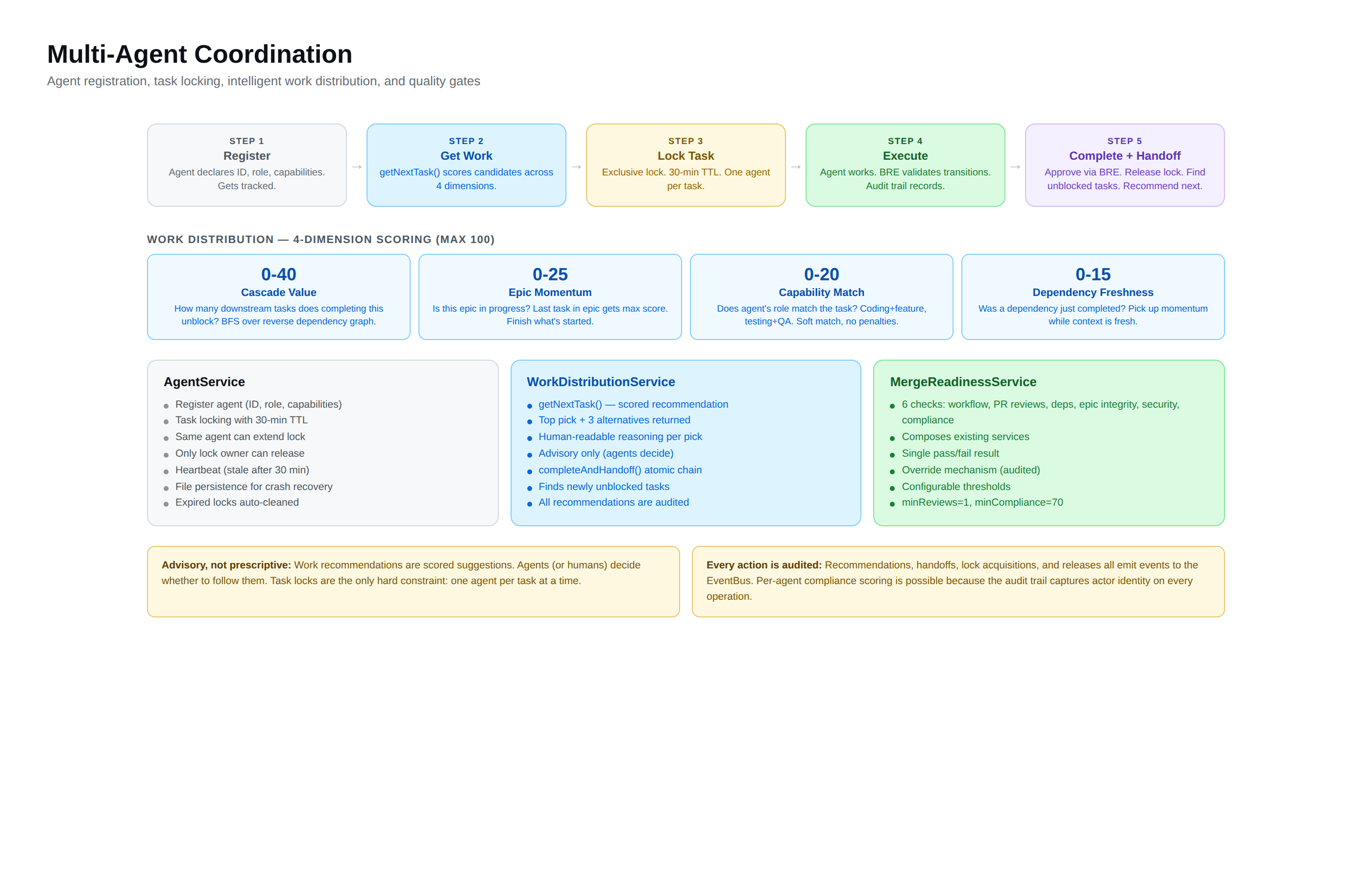
For teams deploying multiple AI agents on the same codebase, ido4 adds coordination: task intelligence that recommends the highest-leverage work for each agent, exclusive locking that prevents duplicate effort, and atomic handoff that keeps work flowing when one agent finishes. Without this, multiple agents produce duplicate work, conflicting changes, and cascade failures.
Multi-Agent Coordination — architecture diagram
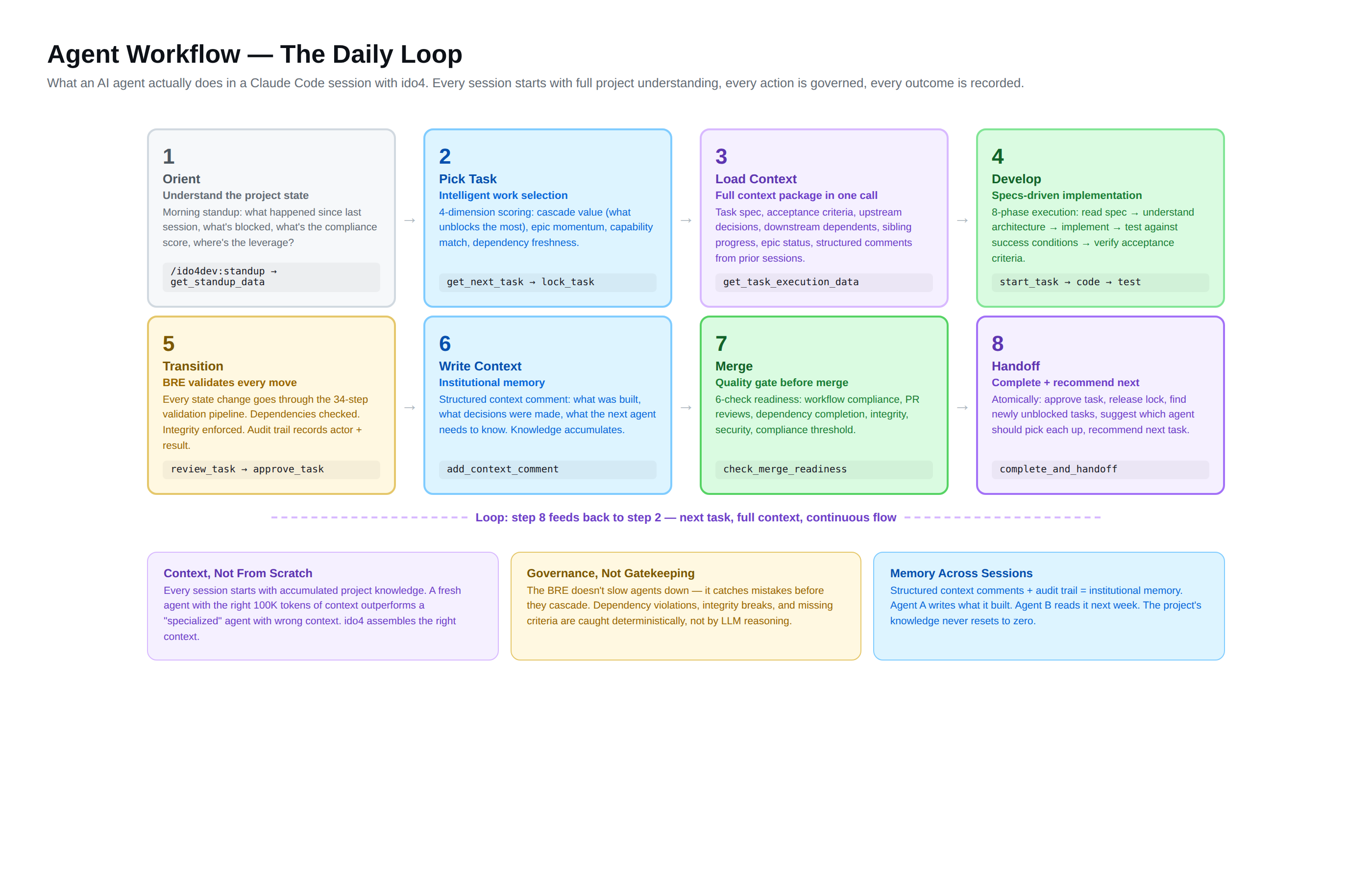
Agent Workflow — daily agent loop
Agent Registration
Each AI agent registers with a unique identity, role, and capability profile:
register_agent("agent-alpha", "Alpha", role: "coding", capabilities: ["backend", "data", "etl"])register_agent("agent-beta", "Beta", role: "coding", capabilities: ["frontend", "auth", "security"])Agent profiles are used for:
- Audit trail — Every action is attributed to a specific agent
- Task locking — Exclusive access to prevent conflicts
- Work distribution — Capability-matched recommendations
- Coordination — Awareness of what other agents are doing
Task Locking
Before an agent starts working on a task, it acquires an exclusive lock:
lock_task(#42, agentId: "agent-alpha")→ Lock acquired. Expires in 30 minutes.Locks prevent duplicate effort:
- Only one agent can hold a lock on a task
- Locks expire after 30 minutes (configurable)
- Agents can heartbeat to extend locks
- The
TaskLockValidationBRE step warns when a task is locked by another agent
Intelligent Work Distribution
The get_next_task tool recommends the highest-leverage task for each agent. It scores candidates across 4 dimensions:
Cascade Value (0-40 points)
How many downstream tasks does completing this task unblock? A task that unblocks 3 others has higher cascade value than a task with no dependents.
#273 Data export → unblocks #274 Batch processingcascade = 15 (1 dependent at depth 1)Container Momentum (0-25 points)
Is the task’s grouping container (epic/bet) close to completion? Finishing in-progress epics or bets is more valuable than starting new ones.
Epic "Data Pipeline": 2 of 7 tasks done (28%)momentum = 7Capability Match (0-20 points)
Does the agent’s declared role and capabilities match the task?
agent-beta capabilities: [auth, security]Task: "OAuth integration"capability match = 13 (title contains "OAuth" → auth match)Dependency Freshness (0-15 points)
Was a dependency recently completed? Tasks whose dependencies just finished have momentum — the context is fresh, the patterns are established.
Task #273 depends on #266 (Data ingestion)#266 was approved 6 hours agofreshness = 15 (within 24-hour window)Scoring Example
get_next_task("agent-alpha")
#273 Data export       score:50  cascade:15 epic:7  cap:13 fresh:15#274 Batch processing  score:17  cascade:0  epic:7  cap:10 fresh:0#271 OAuth integration score:10  cascade:0  epic:0  cap:10 fresh:0
Every score is deterministic — computed from dependency graphs, epic completion ratios, agent capability vectors, and audit trail timestamps. No LLM reasoning involved.
Complete-and-Handoff
When an agent finishes a task, complete_and_handoff performs an atomic operation:
- Approves the task through full BRE validation
- Releases the agent’s lock
- Identifies newly-unblocked downstream tasks
- Recommends which agent should pick up each unblocked task
- Suggests the completing agent’s next task
This eliminates the gap between completion and next assignment.
Coordination State
get_coordination_state provides the full multi-agent picture:
{ "agents": [ { "id": "agent-alpha", "status": "working", "currentTask": "#267" }, { "id": "agent-beta", "status": "available", "currentTask": null } ], "recentEvents": [ { "type": "task.transition", "issueNumber": 266, "transition": "approve", "ago": "6h" } ], "recommendations": { "agent-beta": { "task": "#273", "score": 47, "reasoning": "..." } }}Agents can poll this endpoint to stay aware of what other agents are doing and coordinate effectively.
Governance Hooks
Two PostToolUse hooks monitor governance impact:
-
State Transition Hook — After any task transition, checks: Did this unblock something? Did this create a new blocker? Is this a wave milestone?
-
Container Assignment Hook — After assigning a task to a container (wave/sprint/cycle), checks: Does this create an integrity issue? Does this introduce dependency problems?
Anti-Patterns ido4 Prevents
| Anti-Pattern | How ido4 Prevents It |
|---|---|
| Two agents working on the same task | Task locking with exclusive access |
| Agent starts a task with incomplete dependencies | DependencyValidation BRE step |
| Agent bypasses code review | StatusTransitionValidation enforces the workflow |
| Agent ignores container integrity | ContainerIntegrityValidation blocks split assignments |
| No visibility into agent activity | Full audit trail with per-agent attribution |
| Agents working on low-value tasks | Work distribution recommends highest-leverage work |