
Architecture Overview
ido4 is a layered system where each layer has a clear responsibility and strict dependency direction: upper layers depend on lower layers, never the reverse. This design ensures governance rules are enforced consistently across all operations — validation before mutation, audit trail capture, no bypasses.
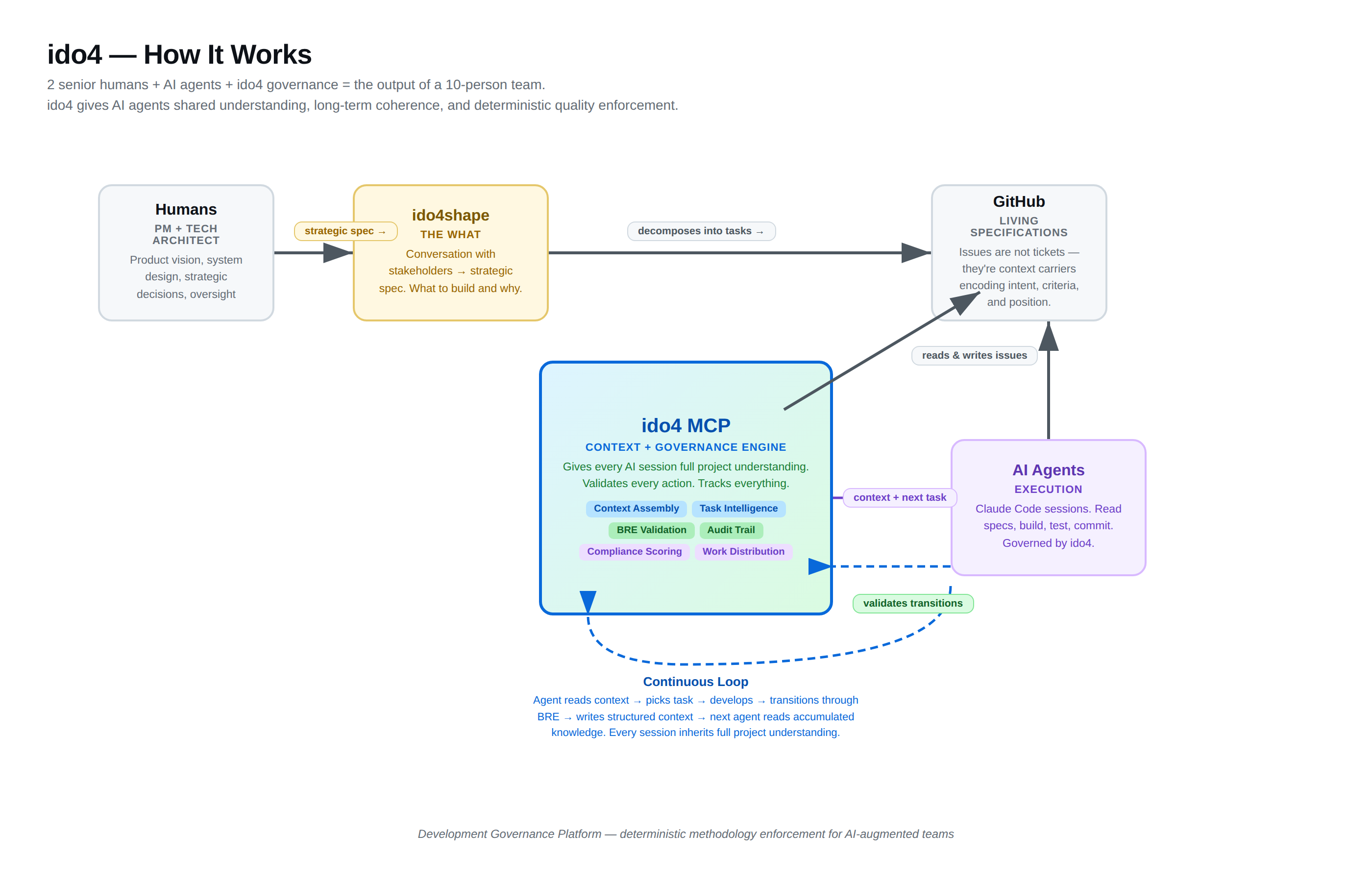
System Block — how ido4 fits in the ecosystem
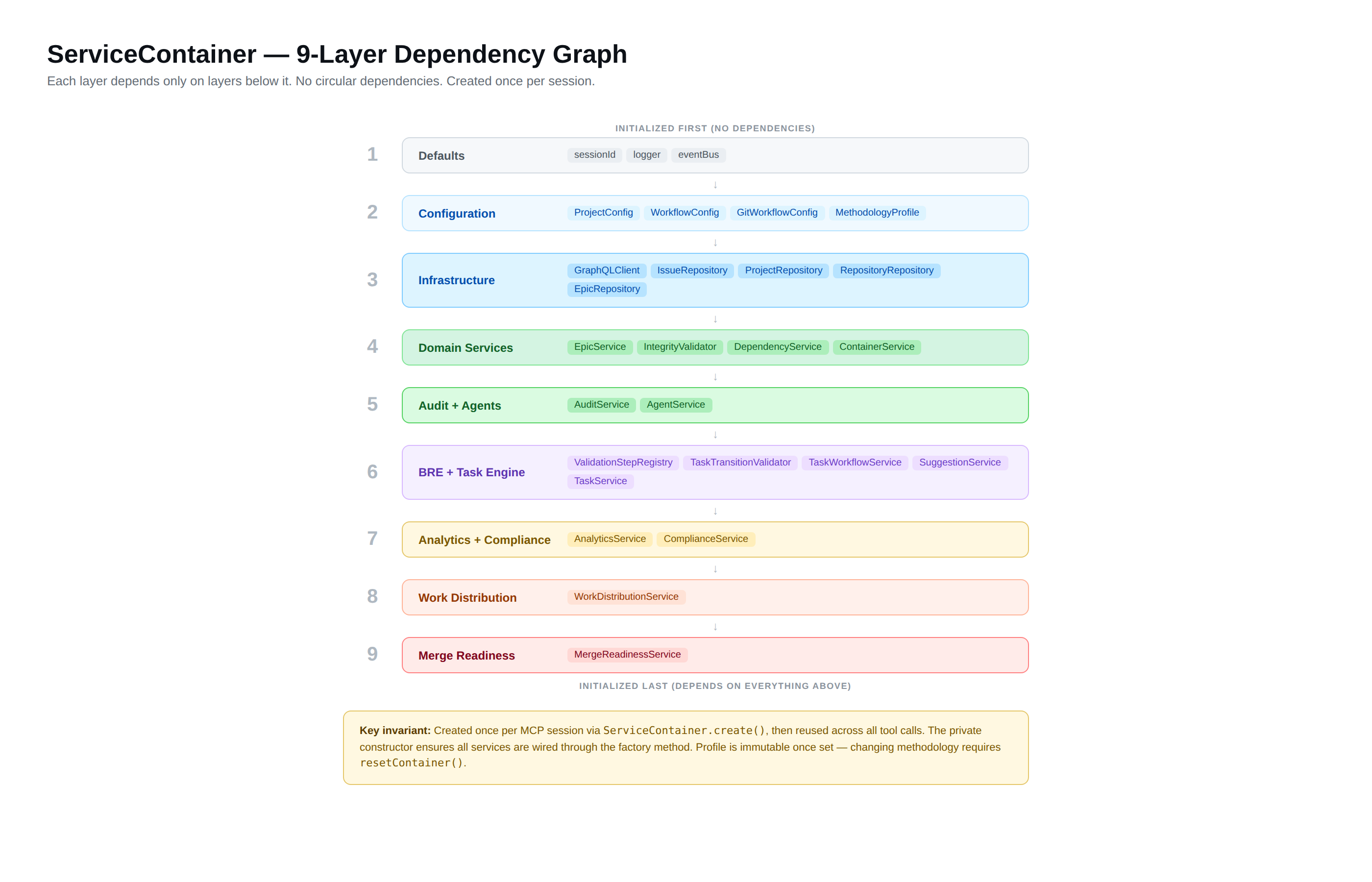
Service Container — 9-layer dependency graph
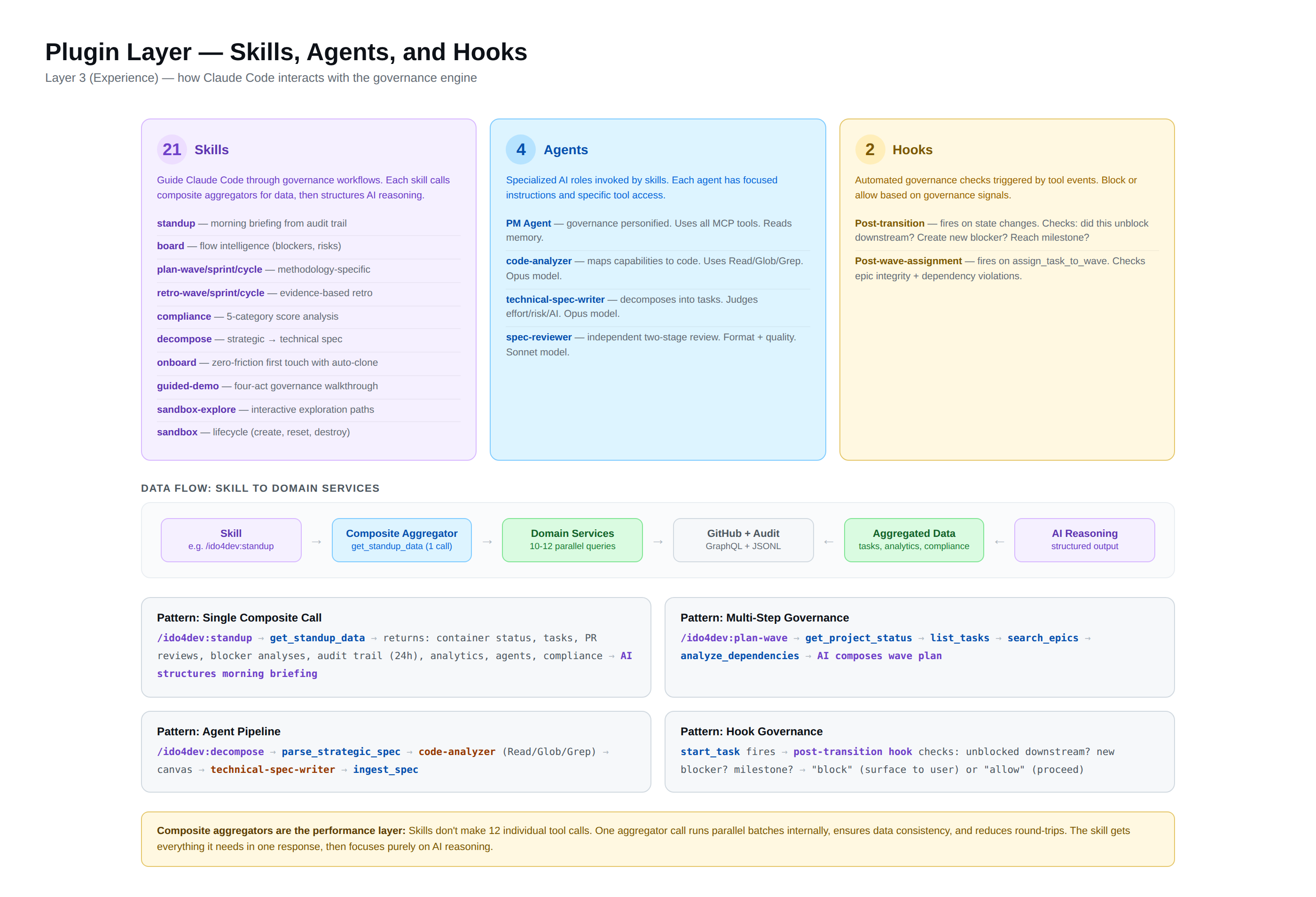
Plugin Layer — skills, agents, and hooks
System Layers
+--------------------------------------------------------------+| Layer 3: Experience ([ido4dev](https://github.com/ido4-dev/ido4dev)) || || 21 Skills 4 Agents 2 Governance Hooks || /standup PM Agent, PostToolUse: || /plan-wave Spec Reviewer, state transitions, || /plan-sprint Code Analyzer, container assignments || /plan-cycle Tech Spec Writer || /board Persistent || /compliance memory, || /retro-* methodology || /health expert || /sandbox-* || /decompose || /spec-validate || /pilot-test |+--------------------------------------------------------------+| Layer 2: MCP Server (packages/mcp -- @ido4/mcp) || || 58 Tools (Hydro) 9 Resources 8 Prompts || 56 Tools (Scrum) project:// standup || 54 Tools (ShapeUp)methodology:// plan-container || audit:// board || Dynamic from analytics:// compliance || profile: compliance:// health || - Transitions coordination:// retro || - Containers execute-task || 6 Aggregators || standup-data, board-data, || compliance-data, health-data, || coordination-data, task-execution-data |+--------------------------------------------------------------+| Layer 1: Core Domain (packages/core -- @ido4/core) || || +--------------------------------------------------------+ || | ServiceContainer (9-layer DI) | || +--------------------------------------------------------+ || | Domain Services | || | TaskService . ContainerService . EpicService | || | DependencyService . ProjectService | || | AuditService . AnalyticsService . AgentService | || | ComplianceService . WorkDistributionService | || | MergeReadinessService . SandboxService | || | IngestionService | || +--------------------------------------------------------+ || | BRE Pipeline | || | TaskTransitionValidator . 34 ValidationSteps | || | ValidationStepRegistry . MethodologyConfig | || +--------------------------------------------------------+ || | Profile Engine | || | ProfileRegistry . ProfileConfigLoader | || | 3 Built-in Profiles (Hydro, Scrum, Shape Up) | || +--------------------------------------------------------+ || | Infrastructure | || | GraphQLClient (retry, pagination, rate limiting) | || | IssueRepository . ProjectRepository | || | RepositoryRepository . EventBus | || +--------------------------------------------------------+ |+--------------------------------------------------------------+| External: GitHub Projects V2 / Issues / Pull Requests |+--------------------------------------------------------------+Design Principles
Interface-Based Dependency Injection
Every service depends on interfaces, never concrete classes. All interfaces are defined in container/interfaces.ts:
interface ITaskService { startTask(issueNumber: number, actor: ActorIdentity, options?: TransitionOptions): Promise<TransitionResult>; validateTransition(issueNumber: number, transition: string, actor: ActorIdentity): Promise<ValidationResult>;}ServiceContainer
The ServiceContainer creates all services in a 9-layer dependency order:
Layer 1: Config (project root, GitHub token)Layer 2: Infrastructure (GraphQL client, repositories)Layer 3: Domain validators (BRE pipeline)Layer 4: Domain services (Task, Container, Dependency, Epic)Layer 5: Audit + Sandbox (event bus subscription)Layer 6: Project + Analytics + AgentsLayer 7: Compliance (reads audit + analytics)Layer 8: Work Distribution (scoring engine)Layer 9: Merge Readiness (6-check gate)Each layer depends only on layers below it. No circular dependencies.
Profile-Driven Generation
The MCP server generates tools, resources, and prompts dynamically from the active methodology profile:
Profile (hydro.ts / scrum.ts / shape-up.ts) | +--> Transition tools (start_task, approve_task, ship_task, ...) +--> Container tools (list_waves, list_sprints, list_cycles, ...) +--> BRE pipelines (which validation steps run for which transition) +--> Prompts (methodology-specific terminology and reasoning) +--> Compliance (lifecycle sequence and scoring weights)Adding a new methodology requires only a new profile — zero engine code changes.
Event Bus
Internal publish-subscribe decouples producers from consumers:
- Producers: TaskService (
task.transition), WorkDistributionService (recommendations) - Consumers: AuditService (persists everything), AnalyticsService (invalidates cache)
Events are fire-and-forget — producers don’t wait for consumers.
Tool Design Philosophy
MCP tools are governed domain operations, not GitHub API wrappers:
- Every write tool goes through the BRE (validation before mutation)
- Every write tool supports
dryRun(validate without executing) - Every write tool records an audit event
- Every tool response follows
{success, data, suggestions, warnings}
Package Boundaries
@ido4/core
Zero dependencies on CLI frameworks, MCP SDK, or terminal formatting. Contains:
- All domain logic (services, validators, analyzers)
- Profile engine and built-in profiles
- Infrastructure adapters (GitHub GraphQL, file persistence)
- Configuration management
- Event bus and audit subsystem
Can be used independently for programmatic governance.
@ido4/mcp
Depends on @ido4/core and @modelcontextprotocol/sdk. Contains:
- Dynamic tool registration from profile (Hydro: 58, Scrum: 56, Shape Up: 54)
- Resource providers (9 resources)
- Prompt definitions (8 prompts, methodology-specific)
- Aggregators (6 composite data fetchers for skills)
- STDIO transport setup
Can be used with any MCP client, not just Claude Code.
ido4dev Plugin (separate repo)
Distributed via the ido4-plugins marketplace. The MCP server is auto-installed from npm via a SessionStart hook. Contains:
- 21 skill definitions (context intelligence, planning, retrospectives, onboarding, sandbox, decomposition)
- 4 agents (PM, spec-reviewer, code-analyzer, technical-spec-writer)
- 2 hooks (SessionStart: MCP server install, PostToolUse: governance signals)
- Plugin manifest
Specific to Claude Code — uses Claude Code’s plugin system. Install: /plugin install ido4dev@ido4-plugins.
Data Flow Example
A task transition flows through all layers:
User: "Start task #42" |Claude Code -> calls start_task MCP tool |@ido4/mcp -> validates input, creates actor identity |@ido4/core TaskService.startTask() | 1. Load task data from GitHub (ProjectRepository) 2. Look up profile pipeline for "start" transition 3. Run BRE pipeline (TaskTransitionValidator) -> 7-9 validation steps execute sequentially -> Result: pass/fail with per-step details 4. If pass: update status on GitHub (ProjectRepository) 5. Emit task.transition event (EventBus) -> AuditService persists to JSONL -> AnalyticsService invalidates cache 6. Return result with suggestions |@ido4/mcp -> formats response as {success, data, suggestions} |Claude Code -> displays result to user |PostToolUse hook -> checks for governance impact